
How Clean Are Portable Restrooms, Really? Inside Brower Inc.'s Cleaning Process
"Are porta potties actually clean?" It is the question everyone thinks but most people never ask out loud. You have probably walked up to a portable restroom at a festival, a jobsite, or a family reunion, taken one look, and turned right around. We get it. That experience is exactly why we built our entire business around never being the provider that causes it.
The truth is that portable restroom hygiene is not a product problem — it is a maintenance problem. A well-serviced unit is cleaner than most gas station bathrooms. A neglected one is the horror story people share on social media. The difference comes down to one thing: how seriously the provider takes the cleaning process. This article shows you exactly what that process looks like at Brower Inc., why Oklahoma's heat makes it harder than most states, and how to tell if your current provider is actually doing the work.
Quick Answer
Yes, portable restrooms are clean — when they are properly maintained. A porta potty serviced weekly with commercial-grade disinfectant has lower surface bacteria counts than the average public restroom door handle. The problem is never the unit itself. It is the provider who skips service visits, under-doses chemicals, or crams too many users onto too few units without adjusting the schedule.
The Honest Answer: Yes, They Are Clean — When Maintained Properly
Let us start with what most portable sanitation companies will not say publicly: not every porta potty is clean. The ones sitting at an understaffed county fair in August with no service truck in sight? Those are not clean. The one your neighbor's friend posted about on Facebook? Probably not clean. But those units are not dirty because portable restrooms are inherently unsanitary. They are dirty because someone failed to do their job.
A modern portable restroom — like the Maxim 3000 units in Brower Inc.'s fleet — is engineered from the ground up for sanitation. The interior surfaces are smooth, non-porous polyethylene that resists bacterial growth and cleans easily with standard disinfectant. The ventilation system pulls air upward and out through the roof vent, drawing odor away from the user. The waste tank is sealed and chemically treated to suppress bacteria and break down solids between service visits.
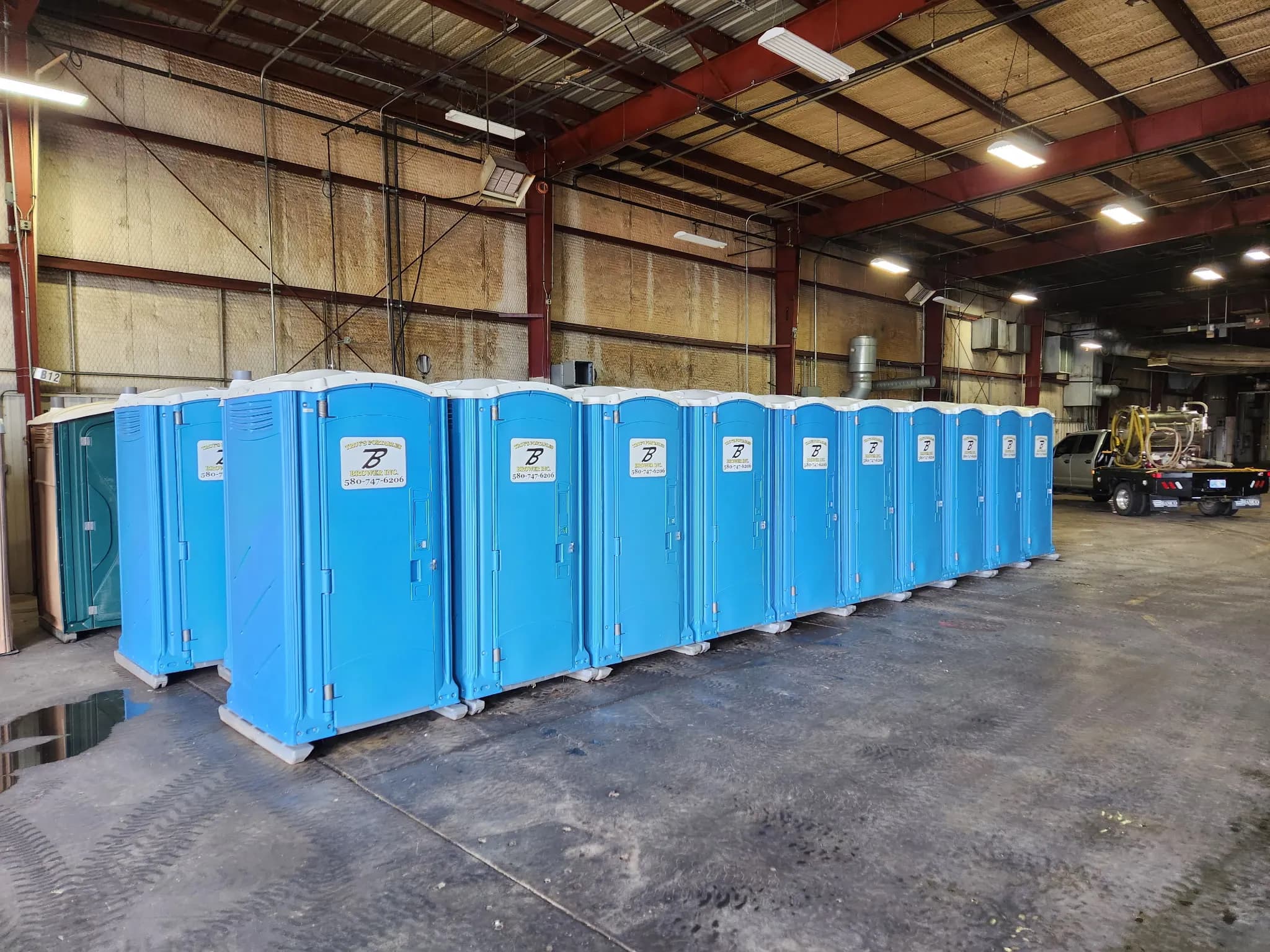
When we deliver a unit to a construction site, an event venue across our Oklahoma and Kansas service area, or a remote oil pad in Kay County, that unit leaves our Newkirk warehouse in the same condition: freshly sanitized, fully stocked, and inspected by hand. The question is not "is it clean when it arrives?" — it always is. The question is "will it still be clean a week from now?" That answer depends entirely on the servicing protocol.
Brower Inc.'s 7-Step Weekly Servicing Protocol
Every portable restroom in our fleet follows the same seven-step cleaning protocol on every service visit. This is not a suggestion list for our technicians — it is a checklist that must be completed in order before the truck leaves the site. Here is exactly what happens when our service vehicle pulls up to your unit:
Empty the Waste Tank Completely
Our vacuum truck connects to the waste port and pumps the entire holding tank until it is completely empty. No partial pumps, no "good enough" — the tank is emptied to zero every single visit. The waste is transported to a licensed treatment facility in full compliance with Oklahoma DEQ regulations. A half-pumped tank is the number one cause of early odor return, which is why we never cut this step short.
Pressure Wash the Entire Interior
Once the tank is empty, our technician pressure washes every interior surface — walls, floor, seat, urinal, and the underside of the roof vent. The high-pressure water blast removes residue, splatter, and buildup that a simple wipe-down would miss. This step is what separates a porta potty that looks clean from one that actually is clean. We use fresh water — never recycled gray water — for every wash.
Scrub All Surfaces by Hand
After the pressure wash, every surface gets a manual scrub with a cleaning solution. The toilet seat, the door handle and latch (inside and out), the urinal, the toilet paper holder, the hand sanitizer dispenser, and the vent louvers are all scrubbed individually. High-touch surfaces like the door latch and seat get extra attention because those are the contact points that matter most for user hygiene.
Sanitize with Commercial-Grade Disinfectant
This is the kill step. We apply an EPA-registered, hospital-grade quaternary ammonium disinfectant to every interior surface. This product is rated to eliminate 99.9% of bacteria and viruses — including E. coli, Staphylococcus aureus, influenza, and SARS-CoV-2 — on contact. We adopted this level of disinfectant during COVID-19 and made it our permanent standard because the science supports it and the cost difference is negligible. Every unit, every visit, full disinfection.
Restock Toilet Paper, Hand Sanitizer, and Deodorizer
Every service visit includes a full restock of consumables. The toilet paper roll is replaced (not topped off — replaced entirely so no one is left with a cardboard tube mid-week). The hand sanitizer dispenser is refilled with 65% alcohol gel that meets CDC guidelines. And the holding tank receives a fresh charge of blue deodorizer chemical — the biocide that breaks down waste, suppresses bacteria, and controls odor between visits. Running out of deodorizer mid-cycle is the fastest way for a unit to go from pleasant to offensive.
Inspect for Damage and Wear
While the unit is clean and open, our technician inspects every structural and mechanical component: door hinges and spring tension, latch operation, vent cover integrity, seat stability, wall panels for cracks or graffiti, and the exterior shell for wind damage or UV degradation. Oklahoma weather — wind, hail, and relentless sun — takes a toll on outdoor equipment. We catch problems at the service stage rather than waiting for a customer complaint. Damaged units are pulled from service and repaired or replaced before the next delivery.
Final Quality Check
Before closing the door and moving to the next unit, the technician does a final walk-through from the user's perspective. They open the door the way a user would, check that the interior smells fresh, verify the paper and sanitizer are accessible, and confirm that the unit is level and stable on its current placement. If anything does not meet the standard, they fix it before the truck moves. This final step takes 60 seconds and catches the small details that add up to the difference between "that porta potty was fine" and "I am never using one of those again."
Total time per unit: approximately 15-20 minutes. Multiply that by a route of 30-40 units per day and you start to understand why the servicing protocol is the most labor-intensive part of the portable sanitation business — and why providers who cut corners can offer cheaper rates. The cleaning is where the money goes, and it is where the quality shows.
What Actually Makes a Porta Potty Smell Bad
Odor is the number one complaint people associate with portable restrooms, and it is worth understanding exactly why it happens — because the cause is always preventable. There is no mystery chemistry involved. A porta potty smells bad when one or more of these four conditions are present:
Under-serviced units
The most common cause by far. When a provider skips a weekly service visit — or does a rushed partial pump without restocking deodorizer — the chemical charge in the holding tank depletes before the next visit. Once the biocide is gone, anaerobic bacteria multiply rapidly, producing hydrogen sulfide and methane. That is the rotten-egg smell people recognize instantly.
Overcrowded usage
A single standard porta potty is rated for approximately 10 uses per day on a weekly service cycle. Put 50 construction workers on one unit and it will overwhelm the deodorizer in two days regardless of how well it was serviced. The solution is not more chemicals — it is more units or more frequent service. Brower Inc. always right-sizes the unit count for your headcount before we quote.
Missing or expired deodorizer
The blue chemical in the holding tank is not just for color. It is a formaldehyde-free biocide that actively suppresses bacterial activity and masks odor compounds. If a technician forgets to add a fresh charge, or adds a weak dose to save on product cost, the chemistry fails. Brower Inc. uses pre-measured deodorizer packets to eliminate dosing errors — the right amount goes in every time.
High temperatures
Heat is an accelerant. Bacterial growth rates roughly double for every 18 degrees Fahrenheit increase in temperature. A unit that smells perfectly fine during an Oklahoma spring at 72 degrees will develop noticeable odor significantly faster when the interior temperature climbs above 110 degrees in July. This factor deserves its own section — because Oklahoma summers are not like summers elsewhere.
The Oklahoma Heat Factor: Why 100+ Degree Summers Demand More Frequent Service
Oklahoma is one of the hottest states in the lower 48 during summer. Between June and September, daytime highs regularly exceed 100 degrees Fahrenheit across our entire service area from Newkirk to Kingfisher to Ponca City. Inside a portable restroom sitting in direct sun, the temperature can reach 120 to 130 degrees — essentially an incubator for the bacteria responsible for odor and unsanitary conditions.
This is not a minor inconvenience — it fundamentally changes the servicing math. A unit that performs perfectly on a weekly cycle during a mild March may need twice-weekly service during a July heat wave to maintain the same level of cleanliness and odor control. National chains operating from regional depots often use a fixed annual schedule that does not adjust for seasonal temperature. That is how you end up with a unit that was fine in April and unbearable in August.
At Brower Inc., we adjust service frequency seasonally as a standard practice. During peak summer months, we proactively recommend upgraded service schedules for any unit that is in direct sun, on a high-traffic site, or serving food-adjacent operations like catering and concession events. We also place units in shaded positions whenever site layout allows — a simple step that can reduce interior temperatures by 15 to 20 degrees and extend the effective life of the deodorizer charge between visits.
Other heat-mitigation practices we follow for every summer deployment:
- High-concentration deodorizer: We switch to a summer-strength formula with higher biocide concentration that remains effective at elevated temperatures
- Roof vent inspection: A blocked or damaged vent traps heat and odor inside the unit — we check vent airflow on every summer service visit
- Tank level monitoring: In extreme heat, we may pump a unit that is only 60% full rather than waiting for 80% capacity — less waste volume means less bacterial surface area and less odor generation
- Event-specific guidance: For summer events, we advise adding 25% more units than the standard headcount formula suggests — both for user comfort and to distribute usage across more tanks
Want units that are actually clean — and stay that way?
Get a free quote from a local Oklahoma provider who takes the cleaning process as seriously as you take your project.
How to Tell If Your Provider Actually Cleans Their Units
Not every portable sanitation company follows a 7-step protocol. Some do the bare minimum — a partial pump and a quick spray — and call it serviced. Here are the signs that separate a provider who genuinely maintains their units from one who is cutting corners:
Green Flags (Signs of a Quality Provider)
- Bright blue liquid in the tank: Fresh deodorizer is a vivid blue or green. If the tank liquid is brown, dark, or has no color at all, the unit has not been properly serviced recently
- Full toilet paper roll: A complete roll (not a partial one) means the technician replaced it entirely rather than topping off whatever was left
- No residue on the seat or walls: A pressure-washed and scrubbed unit has clean, dry surfaces with no splatter marks or film
- Working hand sanitizer dispenser: A filled and functional dispenser means someone checked it during the last service visit
- Pleasant or neutral smell: A clean unit should smell like mild chemical deodorizer or nothing at all — not like an attempt to mask a bad smell with fragrance
- Consistent service schedule: The provider shows up on the same day each week without being reminded. Inconsistent or missed visits are the biggest red flag in the industry
Red Flags (Signs Your Provider Is Cutting Corners)
- Dark or murky tank liquid with visible waste near the top of the tank
- Empty toilet paper holder or a nearly finished roll that was not replaced
- Sticky or gritty surfaces on the seat, handle, or walls
- Empty hand sanitizer with no refill
- Strong, offensive odor detectable from outside the unit with the door closed
- You cannot recall the last time you saw a service truck on site
If you recognize more than two of those red flags on your current rental units, it is time to have a conversation with your provider — or switch to one that takes the work seriously. For long-term rental customers, Brower Inc. provides a service log showing the date and checklist completion for every visit, so you never have to wonder whether the truck showed up.
Troy Brower's Personal Standard: Owner-Operated Accountability
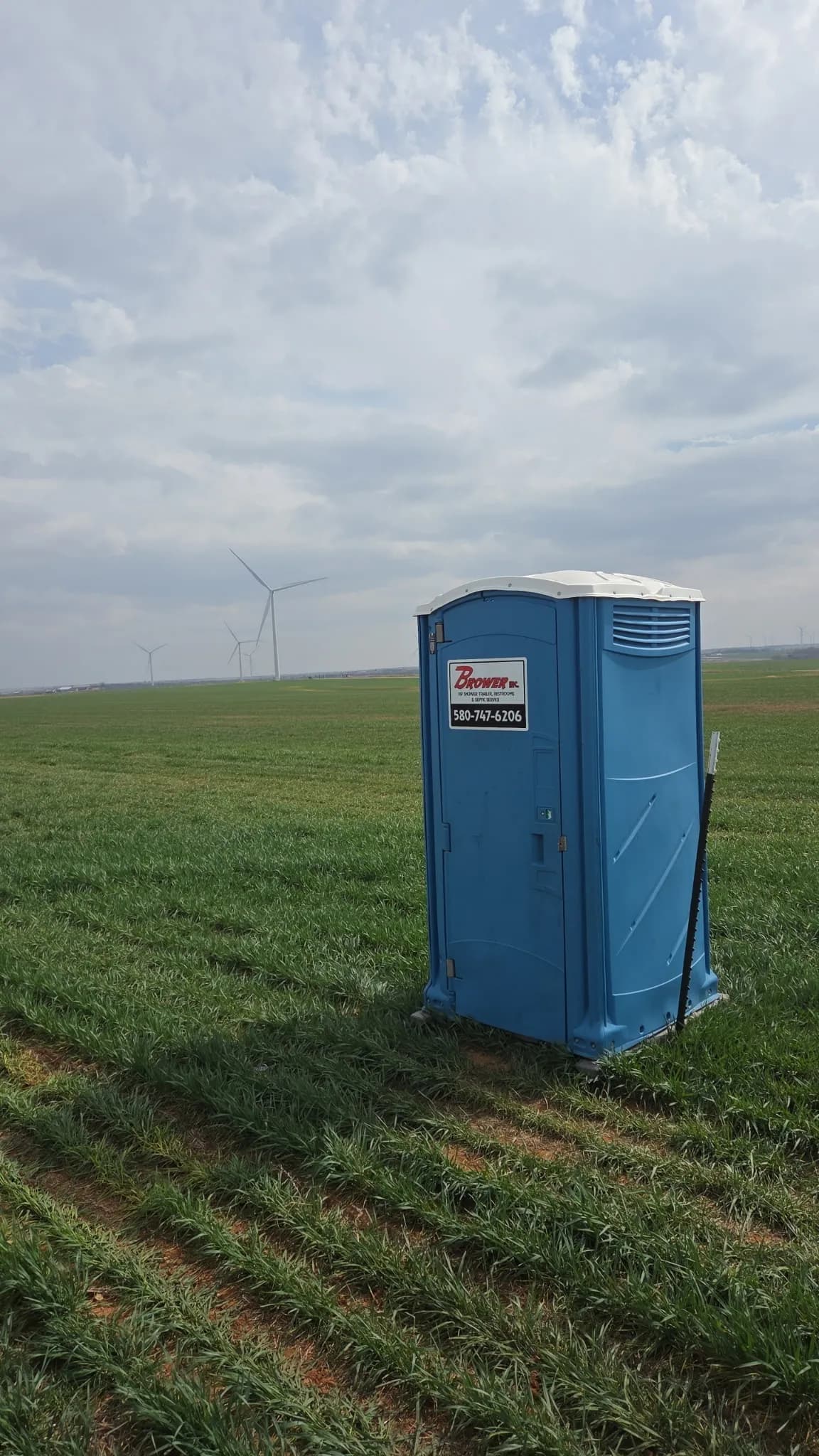
There is one detail about Brower Inc. that changes the entire dynamic of portable restroom cleanliness: the owner is on the truck. Troy Brower does not manage this company from behind a desk in a corporate office two states away. He delivers units. He services routes. He answers the phone when you call (580) 747-6206. And he personally inspects units — both during regular service runs and on unannounced quality checks across active jobsites and event deployments.
This is not a marketing claim. It is the operational reality of an owner-operated portable sanitation company. When your name is on the side of the truck, the cleanliness standard is personal. Every dirty unit is a direct reflection on Troy, his family, and the business he built from scratch in Newkirk, Oklahoma. That level of accountability simply does not exist at a national franchise where the person making the servicing decisions has never met the customer or visited the site.

A note from Troy Brower, Owner
"I have a simple rule: every unit we put on a customer site has to be clean enough that I would use it myself — and clean enough that I would not be embarrassed if my mother used it. That is not a figure of speech. I physically check units on the route. If something is not right, I fix it before I leave. When you call Brower Inc., you are not calling a 1-800 number. You are calling me. And I take it personally when a unit does not meet the standard, because my name is on every one of them."
— Troy Brower, Founder & Owner | Brower Inc., Newkirk, OK
That owner-operated model extends to every part of the service experience. When you request a quote, Troy or his team responds — usually within an hour. When you report a problem with a unit, a service truck is dispatched the same day whenever possible. When you need to add units mid-project, adjust your service schedule, or ask a question about OSHA compliance for your construction site, you get a direct answer from someone who has done the work — not a script from a call center.
For customers who want to see the difference that makes, we offer a simple challenge: compare the condition of a Brower Inc. unit after four weeks of weekly service against whatever you are currently renting. We will let the unit speak for itself.
Pair Your Restrooms with Hand Washing Stations for Maximum Hygiene
If portable restroom cleanliness is a priority for your site — and it should be — the single best upgrade you can make is adding hand washing stations next to your units. The CDC recommends soap and running water over hand sanitizer for removing certain pathogens (including norovirus) that alcohol-based gel cannot eliminate. Our standalone hand washing stations provide fresh water, soap, and paper towels in a self-contained unit that requires no plumbing connection — and they are serviced on the same schedule as your restrooms.
For construction sites, OSHA guidelines strongly recommend hand washing facilities in addition to portable restrooms. For events serving food, many Oklahoma county health departments require them. Adding a hand washing station to your rental is a small cost increase that meaningfully improves the health and comfort of everyone on your site.
Ready for portable restrooms that are actually clean?
Tell us your site, headcount, and dates. We will build the right combination of units, service frequency, and add-ons — and give you a flat price in writing.
Frequently Asked Questions About Portable Restroom Cleanliness
Industry standard is once per week for long-term rentals. Brower Inc. services every unit on a strict weekly schedule that includes pumping the waste tank, pressure washing the interior, scrubbing all surfaces, sanitizing with commercial-grade disinfectant, and restocking supplies. High-traffic units at events or busy construction sites may be serviced 2-3 times per week or even daily depending on usage.
Related Reading from Brower Inc.
Brower Inc. Services & Resources